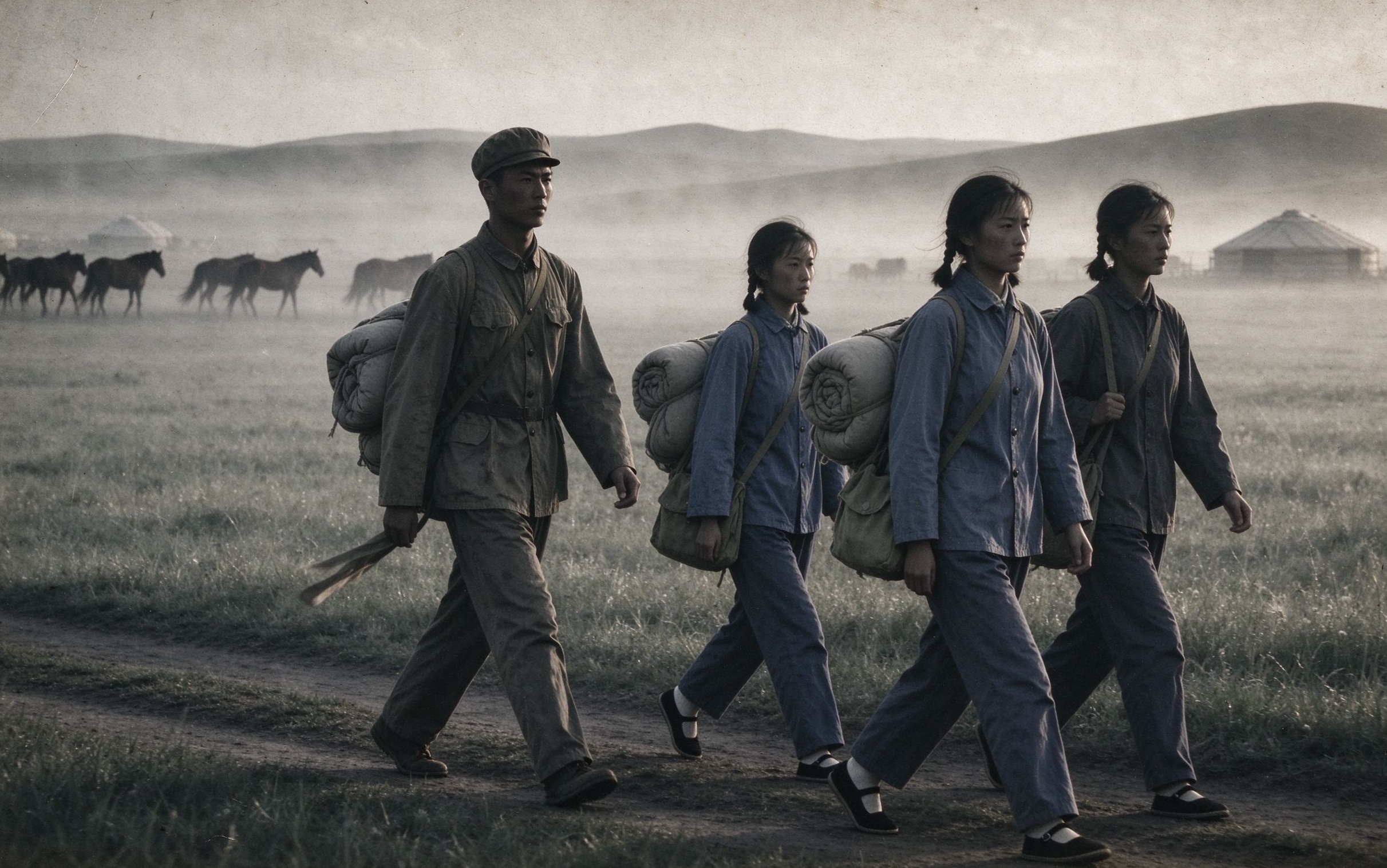
Why Were Young People Sent Down to the Countryside?
The “Down to the Countryside” movement reached its peak in the 1960s and 1970s. In total, nearly 18 million educated urban youths—commonly known in Chinese as zhiqing—were sent to rural areas and border regions.
Mao Zedong’s launch of this movement was far more than a simple political call. It was a choice shaped by the interaction of political idealism, a severe economic crisis at home, and the international security situation.
The main underlying causes can be summarized in three categories.
Economic Crisis: Cities Could Not Provide Enough Jobs
This was the most immediate and fundamental material cause. Against the broader historical background, Chinese cities were facing both a population surge and a severe shortage of jobs.
The baby boom collided with the aftereffects of the Great Leap Forward. The early years of the People’s Republic saw a birth-rate surge. By the late 1960s, this generation was reaching graduation age and needed jobs. Yet, following the setbacks of the Great Leap Forward and the three years of economic hardship, urban industry and the economy had contracted and could not absorb such a large young workforce.
The Cultural Revolution paralyzed economic activity. After it began in 1966, factories and government offices in cities were operating at a near standstill. Commerce and enterprises contracted sharply, and recruitment largely stopped.
School closures created a backlog of graduates. Between 1966 and 1968, nationwide Red Guard rallies and the campaign to “make revolution” brought schooling to a halt. Three cohorts of junior- and senior-high-school graduates—the “Old Three Cohorts” of 1966, 1967, and 1968—were left waiting. Millions of young people had nowhere to continue their education and no jobs in the cities. Leaving them there would have created an enormous economic burden and a major risk to social stability. Sending them to the countryside effectively shifted some of the cities’ employment pressure to the rural collective economy, especially the people’s communes, where there was land to work and, at least, a chance to obtain food.
Political Logic: Containing the Red Guards and Remolding Young People
From the perspective of Mao’s political philosophy and the course of the Cultural Revolution, sending youths to the countryside was a two-pronged strategy: an attempt to bring the disorder of the Cultural Revolution under control while putting revolutionary ideals into practice.
Bringing the out-of-control Red Guard movement to an end. At the beginning of the Cultural Revolution, Red Guards—mainly young students—were mobilized to “rebel,” disrupting the existing Party and state bureaucracy. By 1968, however, the movement had spiraled out of control. Factions engaged in violent fighting, and society descended into disorder verging on anarchy. Mao concluded that the Red Guards had served their political purpose and needed to be removed from the political center—the cities.
The ideal of integrating intellectuals with workers and peasants. Mao distrusted book learning detached from practical life and opposed an education system that, in his view, produced “bourgeois successors.” He believed urban youth were arrogant and estranged from ordinary people. They therefore had to receive “re-education by poor and lower-middle peasants” and undergo hard physical labor—getting covered in mud and developing calluses—in order to purify their thinking and become genuine successors to the proletarian revolution.
National Defense: “Prepare for War and Famine” and Defending the Borderlands
By the late 1960s, China’s external security environment had deteriorated sharply.
The Sino-Soviet split and the risk of a wider war. Relations between China and the Soviet Union had broken down completely, and armed clashes erupted on Zhenbao (Damansky) Island in 1969. The Soviet Union even threatened a “surgical strike” against China’s nuclear facilities. At the same time, the presence of U.S. forces in Vietnam placed additional pressure on China’s national defense.
Opening up land and defending the borders. Under slogans such as “Prepare for war, prepare for famine, and serve the people” and “Dig deep shelters and store grain everywhere,” large numbers of youths were sent to production and construction corps in border regions such as Heilongjiang (the Great Northern Wilderness), Inner Mongolia, Xinjiang, and Yunnan. Although officially assigned to farming, they were incorporated into militarized organizations. They produced goods in peacetime and could serve as militia resistance forces in wartime, helping consolidate national defense and control of the borderlands.
How the Movement Ended—and What It Cost
In December 1968, the People’s Daily relayed Mao’s directive: “It is very necessary for educated young people to go to the countryside and receive re-education from poor and lower-middle peasants.” This marked the beginning of the mass movement on a vast scale.
The movement did, in an objective sense, ease the urban employment crisis and bring education and skills to rural and frontier development. Many sent-down youths worked as village primary-school teachers, barefoot doctors, or accountants. Yet it also radically changed the lives of an entire generation. Many lost the opportunity to pursue formal higher education, creating a break in the development of professional talent. Extreme rural poverty, exhausting labor, and uncertainty about the future exacted a heavy price on their youth.
By the late 1970s, as the Cultural Revolution ended, the university entrance examination was restored, and the urban economy began to recover, sent-down youths increasingly demanded permission to return to the cities. They used various means, including medical leave, replacing retiring workers in their parents’ jobs, and hunger strikes. At the end of 1978, the central authorities adjusted policy, and the movement gradually came to an end. Tens of thousands upon thousands of youths flowed back to the cities, leaving behind one of the most painful and complicated chapters in twentieth-century Chinese history.
How Can the Sent-Down Youth Be Classified? Which Dimensions Help Us Understand Them?
To understand the fate of the nearly 18 million youths affected between the beginning of the Cultural Revolution and around 1980, the greatest mistake would be to treat them as a single, uniform group. They differed in background, in how they were swept into the movement, in their experiences in the countryside, and in their eventual outcomes.
To avoid flattening these experiences into a single stereotype, the group can be analyzed along several dimensions: political identity, the period when they were sent down, the institutional setting of their destination, and family background.
Dimension One: Participation in the Cultural Revolution and Political Outlook
This dimension helps explain the psychological shock and state of mind with which people entered rural life.
Disillusioned Rebel Faction and Red Guard Leaders
Profile: Leaders or key members of various Red Guard factions who had been influential during the early Cultural Revolution, especially in 1966–1967.
Outlook: They had once believed they were the “masters of the country’s future.” In 1968, however, Mao brought them under control and marginalized them through measures such as work-team intervention in schools and the dispatch of youths to the countryside. They often experienced deep disillusionment, a sense of exile, and intense reflection on political reality. Yang Xiguang, later known as Yang Xiaokai, who wrote “Where Is China Headed?”, is one example mentioned in this context.
Reluctant Participants: the “Free-and-Easy” Students and Ordinary Youth
Profile: Students who were not interested in the early Cultural Revolution’s vandalism, factional struggles, and violent clashes. Some stayed at home reading, learning musical instruments, or even fishing.
Outlook: They had never enjoyed the political prominence of the Red Guards. For them, going to the countryside was simply compliance with an unavoidable state order. This group included ordinary members of the “Old Three Cohorts” as well as graduates of the 1970s. Their attitude toward rural life was often one of practical resignation: they wanted to endure the hardship and get through it.
Vulnerable Groups Seeking Political Rehabilitation: Children of the “Black Categories” and Purged Officials
Profile: Young people whose parents were capitalists, landlords, senior intellectuals, or officials denounced during the Cultural Revolution as “capitalist-roaders.”
Outlook: They could be deprived of almost every opportunity for further education or employment in the cities. For them, being sent down could carry a punitive demand to be “remade” and “start anew.” To survive in the countryside, they often felt compelled to work several times harder than others and demonstrate political loyalty through exhausting labor, in an effort to escape the stigma attached to their families.
Dimension Two: When They Were Sent Down
The Cultural Revolution lasted a decade, and the political pressure and flexibility of policy differed greatly from one period to another.
The “Old Three Cohorts” (Sent Down in 1968–1969): An Era of Frenzy and Disillusionment
Who: Junior- and senior-high-school graduates from 1966, 1967, and 1968.
Characteristics: This was the most concentrated group, and its members had experienced the initial, most intense wave of the Cultural Revolution. They were relatively older and more capable of independent thought and reflection. Their psychological reversal was especially severe. Because the placement system was just being established, rural living conditions were often at their worst. They endured great hardship and later became a major force in sent-down-youth literature and critical reflection.
The “New Three Cohorts” and Youth Sent Down in the Middle and Later Cultural Revolution (1970–1976): An Era of Uncertainty and Pragmatism
Who: Students who graduated in the 1970s, during a comparatively more stable phase of the Cultural Revolution, for example after the Lin Biao incident.
Characteristics: They had not experienced the mass fervor of 1966 and may have received preparatory education in “learning from workers” and “learning from peasants” while still at school. By the time they were sent down, placement arrangements—such as the establishment of youth settlements and the allocation of funds—were more standardized. They tended to be pragmatic, with their main concern being how to return to the city through recommendation to a worker-peasant-soldier university, recruitment into a job, or medical leave.
Youth Sent Down at the Tail End of the Era (1977–1980): An Awkward Transition and Release
Who: Young people who, after the Cultural Revolution ended and the university entrance examination was restored, failed to gain one of the limited university places and were still sent to the countryside under the momentum of existing policy.
Characteristics: By then, the movement was already nearing its end. These youths saw older brothers and sisters enter universities or return to cities under policy changes, and their own hopes were no longer focused on rural life. They generally spent the least time in the countryside and soon benefited from the policy adjustments following the central conference on sent-down-youth work at the end of 1978.
Dimension Three: Destination and Institutional Setting
The destination shaped sent-down youths’ living conditions, relationships, and organizational management.
Youth Settled in Ordinary Rural Production Teams: Close to the Grassroots
Living conditions: Small groups were assigned directly to local peasant production teams and had to earn work points, just like local farmers, to support themselves.
Characteristics: They encountered China’s deepest and most immediate rural poverty, sometimes discovering that a full day’s hard work did not even guarantee enough food. At the same time, many developed profound bonds of solidarity with local peasants and gained a firsthand understanding of China’s conditions.
Youth in Production and Construction Corps: A Paramilitary Environment
Living conditions: They were placed in semi-militarized corps, received a fixed wage (though a very low one), and did not rely on work points.
Characteristics: Mostly located in frontier regions, the corps focused on land reclamation and border defense. Their organization was strict and discipline harsh; members were often required to undertake exhausting land-clearing, logging, and road-building. Although the small wage offered some financial security and reduced the immediate risk of running out of food, strict discipline, harsh political scrutiny, and extreme frontier environments could still leave deep physical and psychological scars.
Youth at State Farms, Forest Farms, Mines, and Factories: A Semi-Worker Status
Living conditions: They went to state-owned farms or forest farms near cities or in other regions.
Characteristics: These were considered relatively desirable placements. Social relations could be simpler, since many youths came from the same city, and management was generally less restrictive than in the corps. The work was hard, but the protection associated with the state-owned system often made this group among the first or most likely to obtain permanent local employment or return to the city.
Dimension Four: Family Resources and Routes Back to the City
The route by which a sent-down youth eventually left the countryside often determined their fate, and family background was closely connected to that route.
The Privileged Who Could “Reach the Top” or Use Connections
Route: Through the connections of parents—such as military or government officials who had been reinstated—some returned early through military recruitment, job placement, or selection for the worker-peasant-soldier university program, which began in 1970.
The University Entrance Examination Group: Reversing Their Fate (1977–1978)
Route: Regardless of family background, some persevered in studying by lamplight and passed the university entrance examinations after they were reinstated in 1977 and 1978. Many later became prominent scholars, professionals, and leaders in different fields.
The Indirect Routes: Medical Leave and Replacing Retiring Workers
Route: Many youths from ordinary families resorted to medical retirement or leave, sometimes harming themselves to produce medical evidence, or waited for an urban parent to retire early so that they could take over the parent’s job.
The “Rooted” Youth Left Behind in Their Destination
Route: Some married and had children locally, missed the wave of returns, or ultimately chose—or were compelled—to remain in rural or frontier areas. Their youth and later lives became inseparable from the land they had worked.
Conclusion
Viewed through these four dimensions—political outlook, generational timing, destination and institutional setting, and eventual route back—we can build a more concrete picture of each sent-down youth.
When reading about an individual’s joys and sorrows in history, it is worth asking: Were they part of the Old Three Cohorts or a later cohort? Did they go down wearing a Red Guard armband, or under the stigma of a “black category” family? Were they assigned to a village production team, working with their backs to the loess, or to a corps in the Great Northern Wilderness? Only by asking such questions can the 18 million young people, each with a different fate, avoid being reduced to a single face in a grand historical narrative.