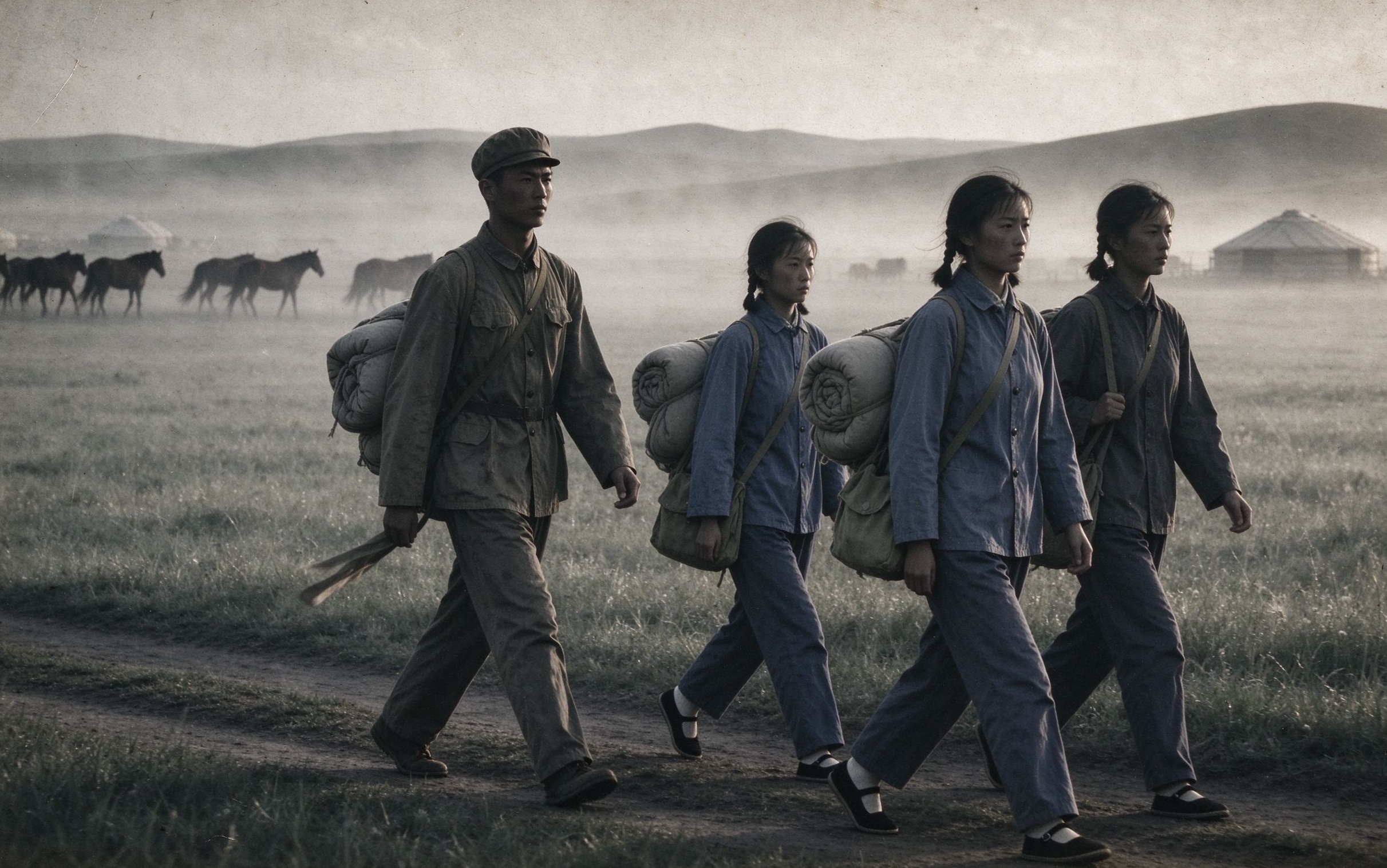
The adolescence of my grandmother’s generation almost completely coincided with the most turbulent eras of the Republic: famine, being sent to the countryside, public struggle sessions, and family background determining one’s destiny. These are not histories they “understand,” but histories embedded in their bodies: an obsession with food, fear and attachment to the collective, and the conviction of the insignificance and powerlessness of individual will in the face of the times. Therefore, in their language, land, rituals, destiny, silence, and endurance are not stylistic choices; they are direct translations of experience. Inviting them to recount oral history requires no explanation to ignite their memories—this is probably what is meant by “visceral pain.” I think what I am doing with oral history is evocation, not narration.
The problem lies right here: evocation-based oral history relies on the interviewer already entering the scene with memories. Yet, I entered empty-handed.
Why empty-handed? Because the channels of information transmission have failed.
Textbooks handle those decades with highly abstract wording—”The Three Years of Economic Hardship,” “The Ten Years of Turmoil.” A few words, a few lines, with conclusions but no flesh and blood. I cannot derive knowledge like “what hunger feels like” from them, which is why I say it is “not knowledge.”
The elder survivors in the family are generally silent—either unwilling to speak due to trauma, or giving up with the attitude of “you won’t understand even if I tell you.” What gets passed down at the dinner table often boils down to ungrounded habits: hoarding food, abhorring waste, and an instinctive wariness of the word “movement.”
The remaining information sources may only be artistic works like films and novels, but they are encrypted themselves: to pass censorship and out of aesthetic ambition, they translate concrete history into fables and symbols—suffering becomes a metaphor for “national character,” and individual fates become footnotes to civilization. This set of codes is tacitly understood by those with memories, but for someone like me without memories, it is double-locked: lacking both the historical key and the aesthetic key.
Thus, I began to seek out “their nostalgia.” I think the phrase “their nostalgia” is very precise. Because the word “nostalgia” is subtle: the attitude of the sent-down youth toward that era is never a simple accusation; it is mixed with attachment—after all, that was where their youth resided, where their vitality and intoxication lay, along with a retrospective gaze at the era that harmed them. This kind of “nostalgia for suffering” can only be held self-consistently by those directly involved; from my perspective as an outsider, their nostalgia is like a stranger’s family album. I know it means a great deal to the owner of the album, but every face is blank to me. I can even feel the photos demanding emotion from me, which I cannot give—this sense of demand seems to be the source of a lingering discomfort.
Our generation actually never rejects history; what we reject is being required to feel moved because we “should.”
Under the context of the current mainstream sent-down youth historical narrative, there is a default collective “we”—our generation, our nation. It assumes that suffering automatically possesses sublimity and that the younger generation should respond with solemnity and emotion.
This grammar was effective in its early days because “we” truly existed. But today’s us grow up in a different emotional system—our pain is rat race/involution, atomization, and a lack of meaning; our modes of expression are irony, internet memes, and “going crazy literature,” instinctively defending against any high-pitched emotional mobilization that demands us to sit up straight.
When a historical work says with a grand, tragic posture, “You should shed tears for this,” while we neither have the memories to cry over nor any natural patience for the word “should,” rejection is almost inevitable.
This is not historical nihilism; rather, it is emotional honesty: we do not pretend to possess feelings we do not have.
Once that outer shell of “should-be-moved” is stripped away, we young people can totally handle the exact same history.
We will examine historical details on Bilibili, and because of a TV show, a game, or a piece of oral history, we will ask, “What actually happened back then?” and suddenly understand why Grandma doesn’t allow leftover food.
The difference lies in the posture—when history appears as a riddle to be solved, available material, or a clue answering “where I come from,” it is open; when it appears as a prefabricated ritual requiring us to recite prescribed emotions, it is closed.
Therefore, what is truly suspended is not that history itself, but the established translation formula of “suffering—fable—sublimity.”
If history is to be passed down, it cannot rely on demanding the next generation enter the emotional system of the previous generation; instead, it must allow us to re-enter those materials with our own questions—nostalgia cannot be inherited, but questioning can.